
What Happens to Your Grief When More Grief Arrives?
This is the post I would have wanted to read after my second, or third, miscarriage in a year.
Because when I was in the middle of it, I was trying so hard to understand my grief. I’d read about the models. I nodded along to the diagrams. I’d found frameworks that kinda made sense, until another loss arrived, and suddenly nothing made sense anymore.
Nobody told me what happens to your grief when more grief shows up. And I think it’s time someone talked about it.
The Models Are Useful – Up to a Point
If you’ve spent any time researching grief, you’ve probably come across at least one of the big frameworks. I talk about three of them in my book, All of These Lines, because they were the ones that genuinely helped me make sense of my own experience.
Here’s a quick recap and then we’ll get to the part nobody mentions.
The Alleged Stages of Grief
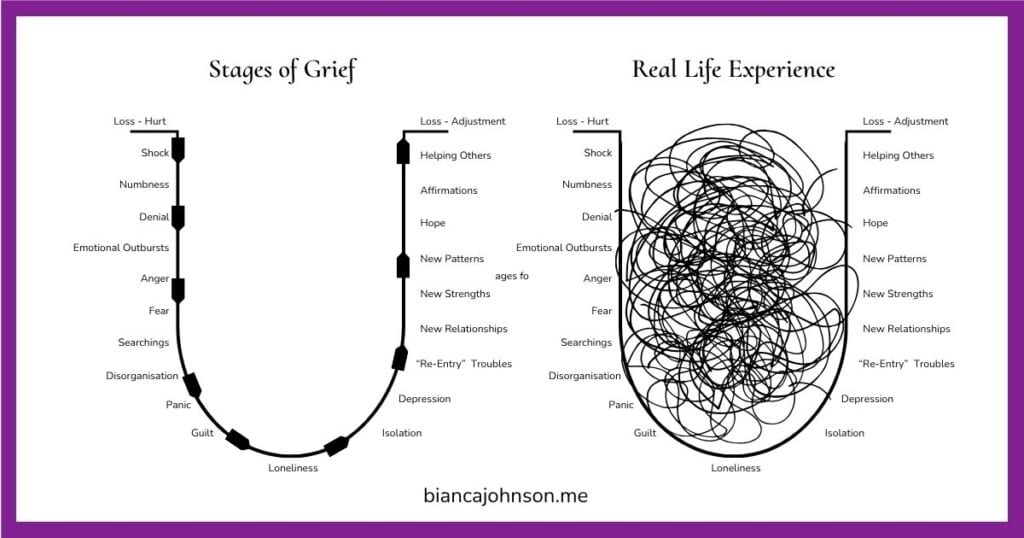
The Kübler-Ross Model is probably the one you’ve heard of. Five stages, or seven, depending on which version you’re reading: shock, denial, anger, bargaining, depression, testing, and acceptance. It’s the most widely known grief model in the world, and it’s also the most misunderstood. It was never meant to be a linear checklist. It was originally developed from research with people facing their own terminal illness. And yet it became the framework society uses to tell grievers when they should be “over it.”
The thing that actually resonates with me about Kübler-Ross is not the stages – it’s the acknowledgement that grief is not a straight line. You jump around. You go backwards. You skip things. You revisit things you thought you’d already processed.
The Ball in a Box Model
The Ball in a Box Model I find much more honest.
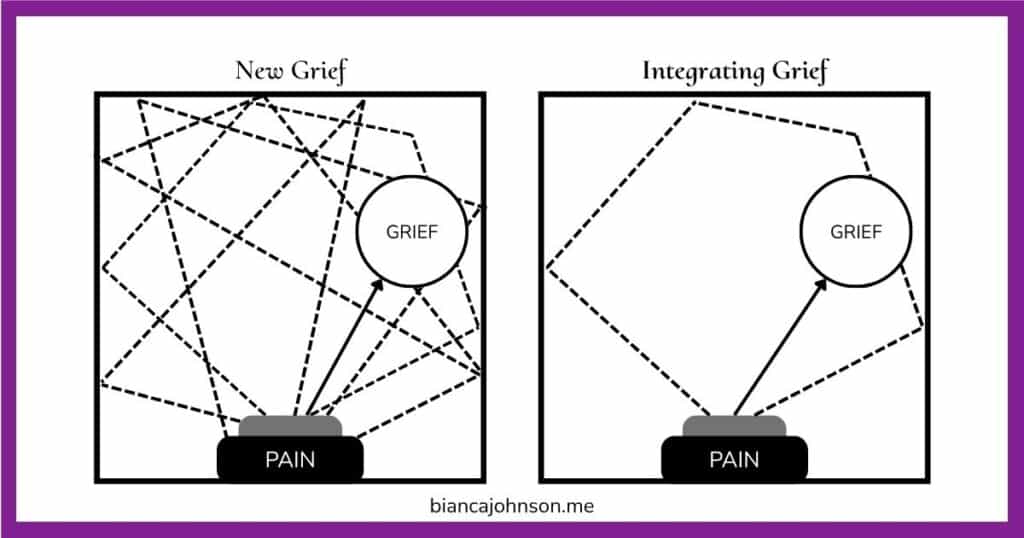
- Picture a box – that’s your life.
- Inside it is a ball — that’s your grief.
- On one wall is a button — that’s your pain.
The ball bounces around the box, and when it hits the button, you feel it. In the early days of grief, the ball is full of energy. It’s bouncing constantly, hitting the button over and over. Over time, the ball doesn’t disappear — but its energy quiets. It bounces less frantically. It hits the button less often. And sometimes, when it does hit out of nowhere, it still takes you completely by surprise. That still happens to me now.
Balls and Jars
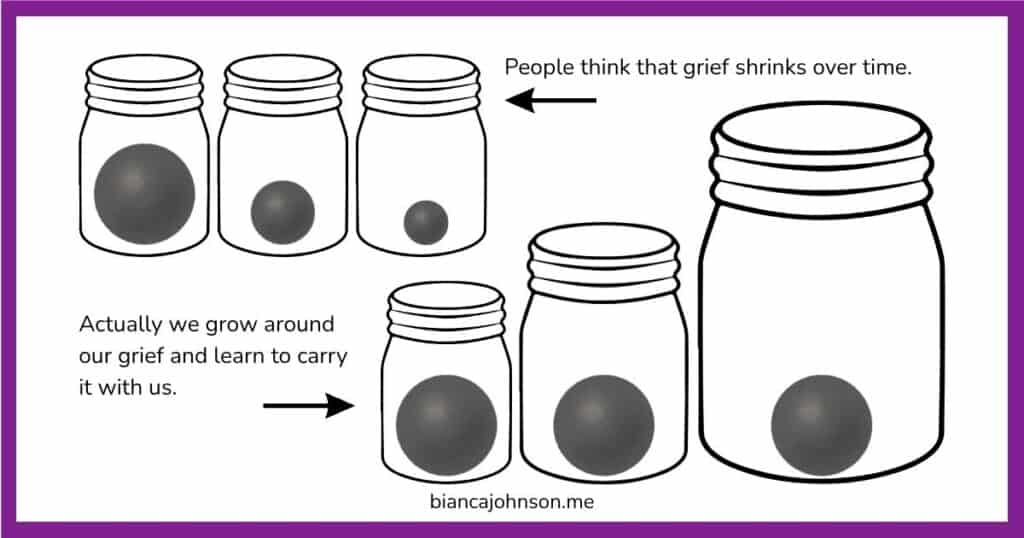
Lois Tonkin’s Growing Around Grief is the one that resonates with me most deeply. Instead of grief getting smaller, your life grows around it. The grief stays, but you build more life alongside it. More capacity. More richness. More ability to hold both the loss and the joy simultaneously. There is no expectation in this model that you should ever forget, or that grief should resolve. You just keep growing around it.
So What Happens When More Grief Arrives?
Here’s the question none of these models really answer.
What happens when you’ve barely had time to find your footing with one loss — and another one comes?
Between marrying my husband in August 2012, and giving birth to my son in May 2014, I had 4 positive pregnancy tests. October 2012, February 2013, May 2013 and September 2013 (when I found out I was pregnant with my son. Eleven months, three miscarriages, grief upon grief upon grief. I had no breathing room to even start to integrate the grief of my first miscarriage, and I was dealing with another and then a few months later another. And then I was pregnant and that baby stuck and I was dealing with being pregnant after loss and all that that carries.
At the time it was so much more grief to carry, I lived in a relative state of denial and focused on the next right step. I don’t even know that I truly even acknowledged my grief in those moments, but when I lost my kitten when I was 6 months pregnant with my son, it was not the kitten I sobbed for – it was the 3 miscarriages that I had powered through, and the loss of my friend and her son a few years earlier, and every other grief that I had been carrying in my heart.
It has been seven years since my last pregnancy loss, and I have had the opportunity to work through so many of my losses and griefs, and to really look at how my life has been able to grow around my pregnancy losses, and integrate them.
And then in the last six months I’ve lost both my in-laws and a friend, and I sit here realising that once again I am carrying more grief yet again. My life feels full of grief again. There are lots of balls in my box, or are there lots of buttons on the walls?
I’ve thought about this a lot. And I’ve asked myself — through each of these frameworks — what actually happens:
Through the lens of Kübler-Ross: If you’re already jumping around between stages for one loss, adding more grief means you’re now potentially jumping around two completely different grief timelines simultaneously. You might be in acceptance for one loss and denial for the next. You might be angry about something that happened two years ago while you’re deep in shock about something that happened last week. The chaos that Kübler-Ross describes in a single grief experience multiplies.
Through the lens of the Ball in a Box: Do you get a second ball? Does the original ball get bigger? Are there now more buttons? I genuinely don’t know — and I think that’s the honest answer. What I do know is that when more grief arrives before the first ball has quieted down, the box feels impossibly crowded. The bouncing becomes erratic in a way that’s hard to describe. You can’t always tell which ball is hitting which button. You just know that the button is being pressed constantly, from every direction.
Through the lens of Tonkin’s jar: Does your life shrink back down? Does all the growth you’d done around the initial grief suddenly feel irrelevant? I think it can feel that way — like you’re starting again. But I also think that the life you grew around the initial grief doesn’t disappear. It becomes part of the container that holds the new grief too. You don’t lose the growth, you just have to make more room for more grief and more life.
What I’ve Actually Found
I don’t have an answer about which model reflects real life the best, but what I can tell you is that any work you have done on grief or your own mental health, helps. As you are met with more and more grief situations in your life, the tools that you have gathered over the years become more and more useful.
For me that looks like turning to writing. Whether in my journal, on social media (I’m loving Threads for conversations), or working on a new book. Writing has been a phenomenal outlet for me and I am grateful to have gotten over myself and accepted that I can actually journal if I’m using my phone or laptop – it doesn’t have to with pen on paper.

Music has also been one of the healing modalities that has played a role in my journey. Finding just the right song to guide me deeper into my feelings, or to lift me out of a wallow. Using music to help me move my body when getting out of bed even feels hard. I joke in my book that my life has a soundtrack.
Learning to control our breathing – the only part of our autonomic nervous system that we can – is such an incredible gift. We can use breath control to slow our heart rates, and to soothe our nervous system. We can use our breath to express our emotions without having to use words. Breathing may be one of the most natural things to us, but it is also in that subconscious way that we can soothe ourselves.

We are mammals and mostly made of water, and often being in nature or water are the places that we can find the most relief from the chaos in our heads and hearts. Putting our feet literally on the ground, in the sand. Soaking our bodies in warm water. Moving in the ocean or rivers at a rhythm we have no control over. Lying in the grass watching clouds overhead. All of these things can help to calm and soothe us when it feels like we’re holding more grief than we can handle.
These are just some of the tools that can help us grow our lives around the grief that just keeps piling on.
What the Grief Models Miss and What You Actually Need to Hear
Most grief models were designed around a single, defined loss. They weren’t written for the person who has lost again and again. They weren’t written for the person who can’t remember a version of themselves that wasn’t grieving something.
And if that’s you — I want you to know something important:
The fact that the frameworks don’t quite fit your experience doesn’t mean your grief is wrong. It means the frameworks haven’t caught up with your reality yet.
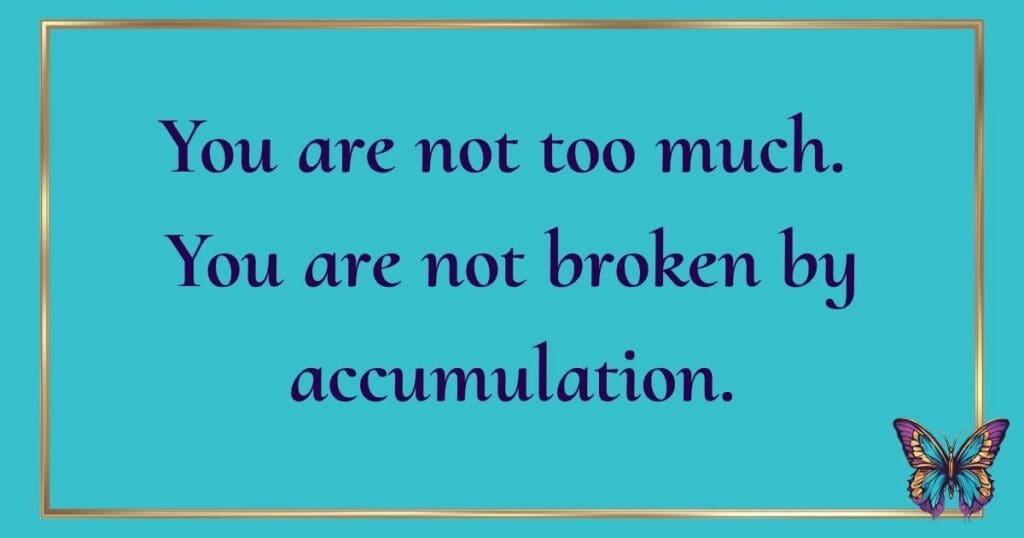
You are not too much. You are not broken by accumulation. You are not failing to process grief correctly because it keeps compounding before you’ve had time to breathe.
Grief is not a linear journey. And it’s certainly not a single one.
In the 17 years my husband and I have been together, we have lost friends and family members, and 5 babies together. We have raised two children, and grieved the loss of a life we dreamed off. We have moved house and changed jobs and done all the other hard things there are. BUT we have grown our lives around that, and I have used my tools to find my way through.
My only wish for you is that you find the tools that help you integrate your grief, and that life gives you respite when you need it most. As hard as it is, you are doing grief right.
If you want to go deeper on the grief models themselves, I talk through all three in my latest YouTube video.
Grief doesn’t come with a manual. But you don’t have to navigate it alone. If you’re ready for some guided tools to help you find your footing, my free Finding Yourself email series is a good place to start: https://biancajohnson.me/finding-yourself-series/

Ready to Find Yourself Again After Pregnancy Loss?
Sign up for the series for FREE. Join at any time and receive the daily emails to guide you back to yourself.
Connect on Socials
You can also connect with me on Facebook, Instagram or LinkedIn where I share more about finding peace, embracing your truth, and living an anti-hustle life.
