
Grief Triggers and Glimmers: What Your Nervous System Needs to Know
I can tell you, with remarkable precision, the exact decor of the doctor’s office where he stood over me and spoke to me like a naughty child.
I can tell you which week of which year a particular date on the calendar started to feel like a held breath (I just had one this last week). I can describe the particular crunch of the stones of a walkway I haven’t walked on since before lockdown. I can tell you exactly what someone said to me online — word for word, where I was when I read it — that made me feel completely, utterly alone in my grief.
Grief Triggers
My brain kept meticulous records of every moment pain arrived unexpectedly. Every ambush. Every trigger. Filed, indexed, retrievable on demand.
What I could not have told you, for a long time, was a single moment where I felt safe.
I don’t think this is unique to me. I think this is what grief does to a nervous system that has been through something it didn’t expect and couldn’t control. Your brain, doing its job, becomes exquisitely attuned to threat. It learns the shape of danger. It catalogues, with extraordinary care, every time the world proved itself unsafe — so that next time, it can warn you faster.
This is not a malfunction. This is protection.
But it does mean that for many of us navigating grief and loss, we become extraordinarily good at one thing and almost entirely untrained in another. We can locate pain with precision. We have almost no practice at all in noticing when we are, even briefly, okay.
And Glimmers
A therapist and researcher called Deb Dana works with something called Polyvagal Theory — the science of how our nervous systems move between states of threat and safety. And she introduced a concept I think about often.
She called it a glimmer.
Not a highlight. Not a silver lining. Not a reason to be grateful when you’re not feeling it. A glimmer is simply a small, often sensory, often unexpected moment that moves your nervous system — even fractionally — towards safety. Towards connection. Towards something that feels, even briefly, like okay.
The reason this concept lands so differently from toxic positivity is precisely because it doesn’t ask you to reframe your pain or manufacture happiness. It just asks you to notice. To become, slowly, as good at cataloguing the moments of safety as you’ve become at cataloguing the moments of threat.
Not instead of the grief. Alongside it.
My grief triggers and glimmers
I was writing about glimmers years before I had the word for them.
In my memoir All of These Lines, I wrote about small moments during one of my pregnancies where something in me exhaled — what I called, without knowing the clinical language, glimmers of positivity. Tiny pockets of air inside something that was mostly fear. I didn’t know what to do with them at the time. They felt almost suspicious, like I wasn’t allowed them.
That, I think, is the other thing grief does. It makes us mistrust the okay moments. As if noticing a glimmer is somehow a betrayal of the loss. As if feeling safe for thirty seconds means you’ve forgotten, or moved on, or aren’t taking the grief seriously enough.
You haven’t. You’re not. You are.
A Glimmer is not the opposite of Grief
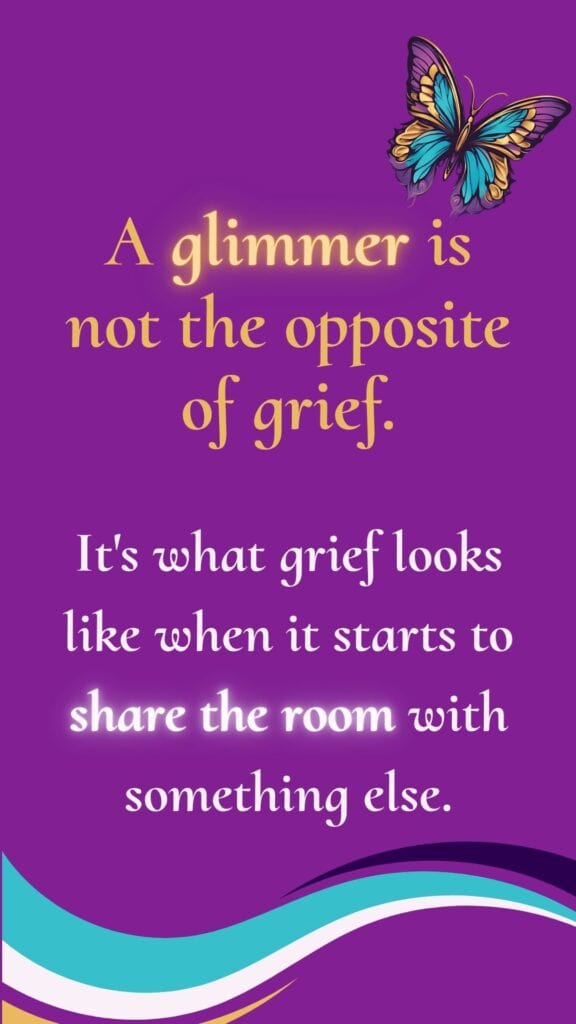
A glimmer is not the opposite of grief. It’s what grief looks like when it starts to share the room with something else.
So what does it actually look like to build the other catalogue? The one that holds the safety, not just the threat?
For me it started small and stayed small. Specific and sensory, the way glimmers always are.
The sound of the green woodhoopoes in our garden — iHlekabafazi in Zulu, which means cackling women, which is exactly right — flying tree to tree with that noisy, joyful chatter that sounds, to my nervous system, like being somewhere far from anything hard.
The first bite of a good lemon meringue pie – the tart filling then the sweetness coming through. The slight crunch of a really good meringue topping and the gooey marshmallow inside. The buttery, crumbly crust. It’s a true taste sensation.
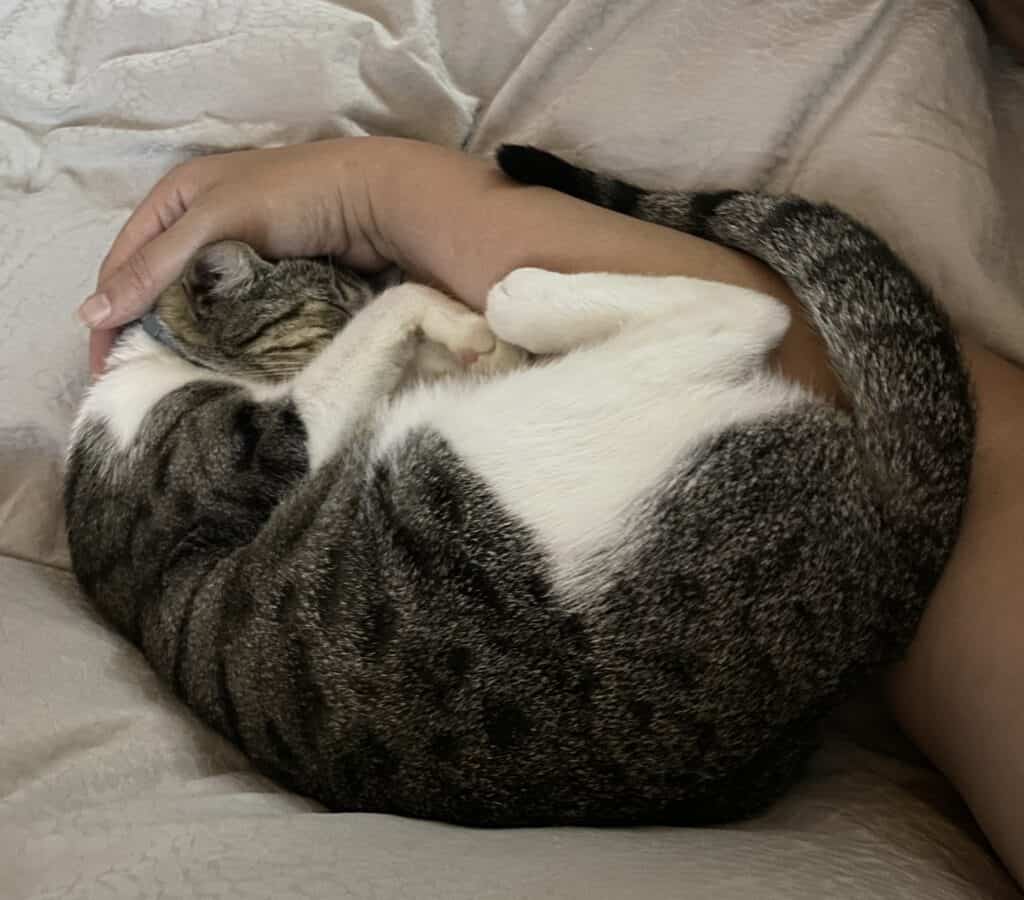
My kitten, Jingle, tucking her head into my palm in the dark. Usually after she’s just come in, sopping wet and shlurping herself. We rescued her as a tiny kitten who was clearly abandoned too early. She would never survive in the wild, but she is my favourite snuggler. The moment she curls up into my hand is always my favourite.
The ha-whump of breeding pair of grey crowned cranes landing in the wetland at sunset. If I happen to hear them when they leave early in the morning, it’s the same little jolt of glee.
None of these fixed anything. None of them were supposed to.
They were just evidence. Small, accumulating, stubbornly present evidence that my nervous system could still find its way to safe. That okay still existed in the world, even in the midst of the heaviest of moments.
And over time — not quickly, not linearly, but over time — that evidence started to matter.
Start a Glimmer Library
Here’s what I want to leave you with.
Your brain will keep cataloguing the triggers. That’s not going to stop, and honestly, you wouldn’t want it to — that system exists to protect you and it does just that. But you can build a second catalogue alongside it. A glimmer library. A quiet, growing collection of the moments your nervous system said safe.
- A note on your phone.
- A page in your journal.
- A photo album you add to slowly.
Over time, the pattern becomes visible — this is what opens me up — and that self-knowledge is more useful than I can fully explain here.
You don’t have to choose between honouring your grief and noticing the glimmers. Both can be true at the same time. In fact, I think that’s exactly what healing looks like — not the absence of triggers, but the slow, steady growth of evidence that okay is still possible.
Start noticing. Even once. Even today.
Watch The Video
When Everything Is a Trigger — Here’s What Actually Helps
I spoke about glimmers and triggers on my YouTube channel — including the clinical concept, and some of my own glimmer stories in more detail. If you’re a listener rather than a reader, start here:
If You’re in a Hard Season Right Now

My free five-day email series — Finding Yourself Again After Pregnancy Loss — is a gentle, practical starting point. No pressure, no toxic positivity. Just honest, useful support that meets you where you are.
Join the free series here →You’ll flow straight into Lines from Bianca after — my weekly newsletter, every Thursday.

Ready to Find Yourself Again After Pregnancy Loss?
Sign up for the series for FREE. Join at any time and receive the daily emails to guide you back to yourself.
Connect on Socials
You can also connect with me on Facebook, Instagram or LinkedIn where I share more about finding peace, embracing your truth, and living an anti-hustle life.
