
Love, Debt and Pregnancy Loss: The Financial Cost No one Talks About.
Nobody told me that debt and pregnancy loss were related.
They told me it would be painful. They told me to take it easy, wait a cycle, try again. They said “these things happen” and “at least you know you can get pregnant.” But not one person sat me down and said this is going to cost you. The appointments that aren’t covered. The supplements. The alternative therapies you’ll try because you’re desperate and you’ll try absolutely anything. The therapist you’ll need. The chiropractor. The herbalist. The nutritionist.
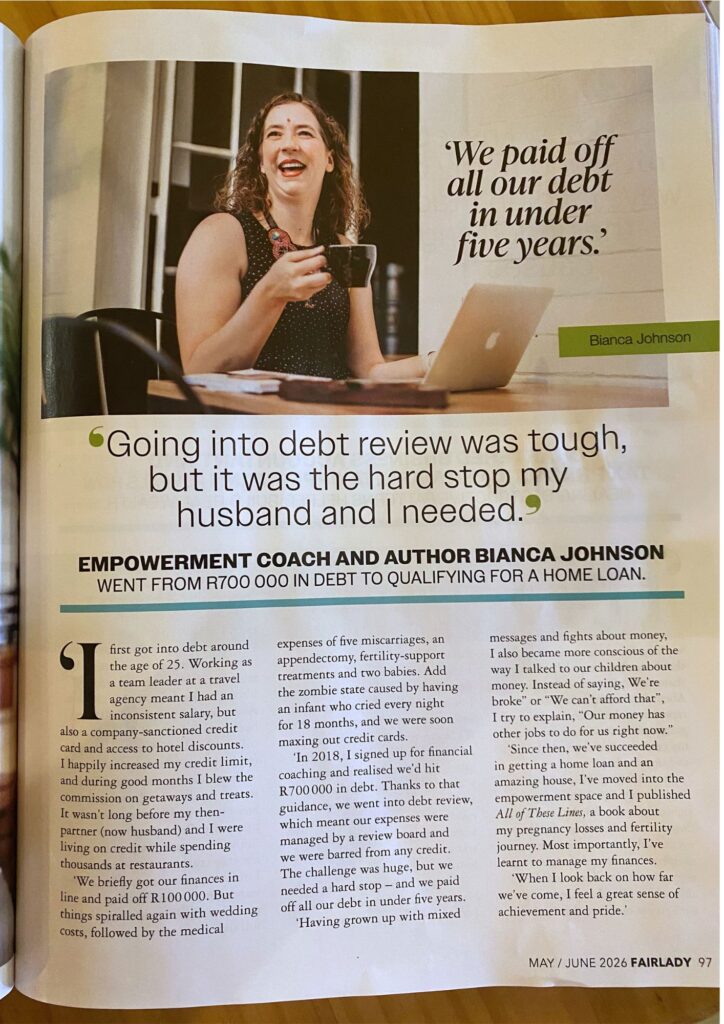
I was recently featured in an article in Fairlady Magazine about debt and financial recovery, and I shared some of the broad strokes of our story, how Brian and I went into debt review with R700 000 in debt, and came out the other side in under five years. What I didn’t get to say in full is the part that sits underneath that number. The part that I think a lot of loss parents carry quietly, sometimes for years, without ever naming it.
So this is me naming it.
Our debt story didn’t start with pregnancy.
Both Brian and I had debt before we met. I’d worked in travel for years with an unpredictable salary and a company credit card, a combination that is exactly as dangerous as it sounds. Brian had his own financial pressures. Before we got married we’d actually made real progress. We’d paid off over R100 000, we were budgeting, using apps, making better choices. We were doing ok.
And then I fell pregnant.
And had doctors’ appointments.
And then miscarried.
And the appointments weren’t covered by medical aid.
Then it happened again. And there were supplements to get and alternative therapies to try. A chiropractor. A nutritionist. A herbalist. I was trying everything I could to fix what was wrong with me, because when you’re losing pregnancies you don’t sit still, you research, you reach out, you spend. I started working with a therapist and realising just how much I had to work through.
Then it happened a third time, and we had a more expensive doctor now. I was panicking and choosing to do more blood tests than my medical aid covered. And then we lost the baby again. And the debt started to ramp up and my mental health started to struggle and managing a budget was just one more thing on my plate.
Oh, and I had an emergency appendectomy in between there too. Which wasn’t covered by medical aid because the doctor, rightly, refused to do open surgery, which my medical aid was insisting on. More debt.
Then I fell pregnant with Kyle. And although the pregnancy went smoothly, I had a therapist I saw every two weeks for the whole pregnancy. More scans than my cover included. More appointments with my gynae. There was also the relief of finally being able to take a baby home, and so we did all the things and bought the best of what we could afford for him.
And the therapy continued, although not as frequently. The chiropractor appointments remained regular. I dropped the nutritionist, and my urine went back to being regular priced.
And then we brought Kyle home and he didn’t like the car and he didn’t like to sleep. Zombies are really bad at budgeting. Kids are expensive.
So our budget suffered more and our debt got bigger again, and the banks kept offering more overdraft and more credit, and we accepted because we didn’t know how to get out of the hole we were in.
Then my gynae moved, and it was a 45-minute drive each way for appointments. And then I had a missed miscarriage despite all the meds and supplements I was on. And then I needed to ramp up the therapy again.
By the time Ayla came along we were pretty deep. There was so much month at the end of the money. And then I chose to start my own business. With a three month old. What was I thinking?
What debt and pregnancy loss really look like.
Not all of our debt was because of our pregnancy losses. But there is an undeniable correlation between the times our debt increased most sharply and the losses we experienced. Pregnancy loss made a bad situation worse. It made a bad situation worse because it is expensive. And it is exhausting. And exhausted, grieving people are not in any state to be making good financial decisions.
Nobody talks about this.
We talk about the emotional cost of pregnancy loss. We talk about the toll it takes on relationships and on your sense of self. But the financial conversation, the one where we acknowledge that miscarriage, recurrent loss, fertility treatments, alternative therapies, extra scans, therapists, supplements, and the general desperation to try absolutely everything costs actual money, that conversation almost never happens.
And when you’re already struggling financially, the guilt about the money is just one more heavy thing to carry alongside the grief.
The hard stop.
In 2018 my word of the year was Try Everything. It led me to a money coach, and finally to debt review. For us, debt review worked. It was hard. Our expenses were managed by a review board and we were barred from any credit. The challenge was significant. But we needed a hard stop, and we paid off all of our debt in under five years.
We’ve since qualified for a home loan, and we have a house we love. I’ve learned to manage our finances and investments in ways that feel sustainable and real, not just reactive.
But I want to be clear: I don’t share that to make it sound easy or linear. It was neither. I share it because I spent years believing the financial mess was proof of my failure as a wife, as a responsible adult, as someone who should have had it more together. And the truth is that we were doing our best under circumstances that were genuinely, legitimately hard.
If you’re reading this and you see yourself in any part of this story.
Maybe you’re in the middle of a loss right now, watching the costs add up. Maybe you’re further down the road, carrying debt that quietly traces back to a season of trying and losing and trying again. Maybe you’ve never connected the two things, and reading this is the first time it’s occurred to you that the financial weight you’re carrying has a name.
You are not bad with money.
You were surviving something enormous.
The fuller, messier version of my story, including everything that sits behind the numbers, is in my memoir, All of These Lines: My Story of Pregnancy, Loss and Hope. If any part of what I’ve shared here resonates with you, it might be the book you’ve been looking for.
And if you’d rather start with a conversation, I’m always up for a coffee chat.
Download the Fairlady Article here.

Ready to Find Yourself Again After Pregnancy Loss?
Sign up for the series for FREE. Join at any time and receive the daily emails to guide you back to yourself.
Connect on Socials
You can also connect with me on Facebook, Instagram or LinkedIn where I share more about finding peace, embracing your truth, and living an anti-hustle life.
